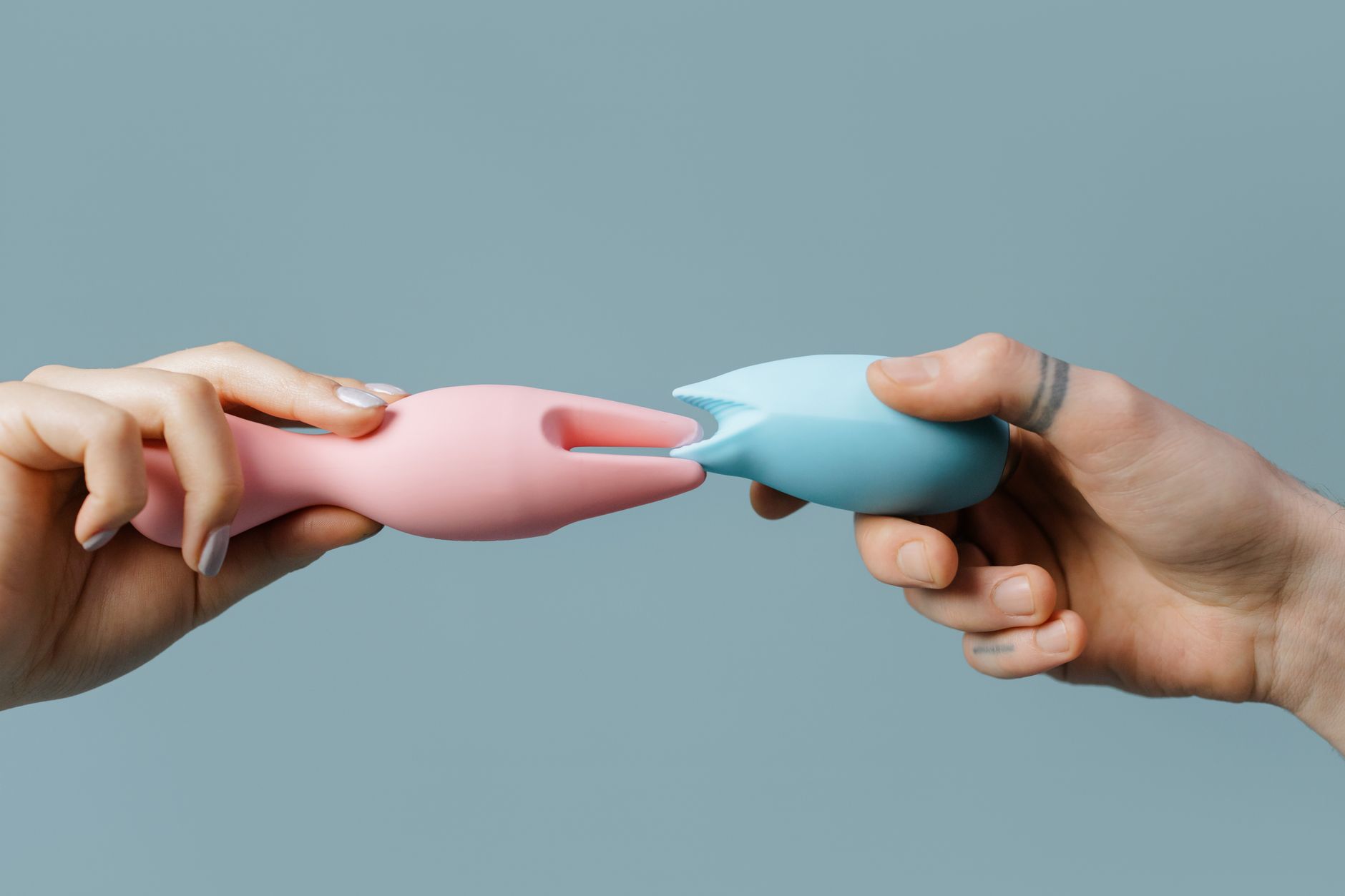
Let's start with what nobody mentions
Condoms are non-negotiable for many couples. They're reliable, accessible, and necessary. They're also a literal barrier between nerve endings and sensation. For a lot of people, that barrier costs them orgasms they could have otherwise.
Here's the thing: you don't have to choose between protection and pleasure. But you do have to actively redesign the experience when condoms are in the picture. A clitoral vibrator like the Lem becomes essential infrastructure in that redesign, not a luxury upgrade.
Why condoms specifically affect clitoral pleasure
Penetration dulls sensation in a few predictable ways. The condom's material (latex, polyisoprene, polyurethane) creates a buffer that reduces friction and feedback. Thickness varies, sure, but even ultra-thin condoms still interrupt the direct contact your nerve-rich clitoris needs for reliable stimulation.
The clitoris has more nerve endings in a smaller space than almost anywhere else on your body. It's exquisitely sensitive to direct contact, texture, rhythm, and temperature. A condom doesn't touch the clitoris, but it changes the arousal path that usually leads to clitoral stimulation during penetrative sex. Fewer sensations upstream means fewer building blocks for orgasm downstream.
That's not a failure of condoms. It's physics.
Where a lemon clitoral vibrator enters the picture
A dedicated clitoral vibrator bypasses the condom problem entirely. It creates its own direct stimulation path that has nothing to do with what's happening during penetration. The Lem, for example, uses suction and pulse patterns that work on the external clitoris, independent of internal sensation.
This is why couples I've worked with often say that adding a lemon vibrator actually made condom sex feel better overall, not just tolerable. You're not trying to wring sensation out of reduced contact. You're building a parallel pleasure channel that was always available but got overlooked.
The mental shift is important too. Instead of "condoms make this feel worse," the conversation becomes "we're adding something new." Different energy entirely.
How to actually integrate it into partnered sex
There are three practical setups worth trying:
1. Before penetration. Use the Lem to build arousal and get close to or through an orgasm before your partner enters. This takes the pressure off the penetrative part to do all the work. You're already satisfied, so whatever sensation you get from the condom-covered penetration becomes bonus.
2. During penetration, external-only. While your partner is inside you, use the Lem on yourself. The two stimulation sources work synergistically. Some couples find this rhythm almost meditative. The Lem stays steady while the other form of contact varies.
3. After penetration as a finish. Get most of the way there during sex, then use the vibrator for the final push to orgasm while your partner is still present. This keeps momentum without asking the condom-dulled sensation alone to complete the journey.
Start with option one. It's the lowest-pressure variation and lets both of you get used to the vibrator's presence without trying to solve everything at once.
Communication before you try it
If your partner hasn't been involved in a vibrator during sex before, a conversation beforehand matters more than you'd think. Not a big production, just clarity: "Condoms change how much I can feel. I want to try adding the Lem so the whole thing feels better for me. This isn't about you or anything you're doing wrong. It's about me getting more pleasure."
That framing prevents the most common misunderstanding: the belief that introducing a vibrator means the partner's stimulation isn't enough. It doesn't. It means condoms created a sensory gap, and you're filling it.
If your partner seems hesitant, ask what the hesitation is actually about. Often it's not the vibrator itself. It's anxiety about being replaced or judged. Those conversations move fast once they're named.
Picking the right settings and patterns
When you're using a lemon clitoral vibrator like the Lem with a partner, start lower than you might use it solo. The reason: you've already got arousal building from penetration and physical closeness. You don't need to start at max intensity.
Many people find patterns 2 or 3 (mid-range, rhythmic pulses) work best during partnered sex because they're easier to sync with the other movement happening. The fastest patterns can be overstimulating when you've already got multiple sensations layering.
You're not chasing an orgasm when you first introduce this. You're learning how your body responds to the combination. That takes at least three attempts to land.
The pleasure architecture changes
Here's something I've observed with couples who integrate clitoral vibrators while using condoms: their overall satisfaction often goes up, not just during condom sex, but across the board. Why? Because you've given yourself agency.
You're no longer passive waiting for a condom-muffled sensation to build into pleasure. You're actively creating the stimulation you need. That shift is psychological and physical. Physically, you get reliable sensation. Psychologically, you're not resentful about the barrier method because you've taken responsibility for your own pleasure.
That's actually how long-term relationships sustain good sex. Not by pretending condoms don't change things, but by acknowledging it and building better infrastructure around it.
If one of you has lower sex drive than the other
This setup also helps when condom sex is a point of friction because of mismatched desire. If you're less interested in penetration but your partner wants it, a vibrator can make the whole experience feel faster and more satisfying for you. You're not gritting your teeth waiting for it to be over.
For partners with higher drive, it changes the dynamic too. You get more enthusiasm from the person you're with when they're actually enjoying themselves instead of tolerating the experience for your sake.
A note on lube with condoms and vibrators
Water-based lube is essential. It works with condoms (silicone lube can degrade latex), and it enhances how the vibrator feels on clitoral tissue. Apply fresh lube to the Lem's cup before you use it. The added slickness makes the suction pattern more effective and more comfortable.
Reapply as you go. Lube that was perfect five minutes ago dries. This isn't a failure. It's just the mechanics of the situation.
When to adjust your approach
If you're trying this and it's not clicking after a few attempts, the issue might be any of these: wrong vibrator settings, not enough arousal time before adding it, too much pressure to have an orgasm, or genuine incompatibility with this partner during condom sex.
The last one is worth naming. Some couples discover that condom sex just isn't their thing no matter what tools they add. That's information. It might shift how you approach barrier methods together, or it might shift the relationship. Both are valid outcomes.
But most of the time, a clitoral vibrator transforms condom sex from something you tolerate into something you actually want. The sensation problem gets solved. Everything else gets easier from there.
People also ask
Can I use a lemon vibrator with any type of condom?
Yes. The vibrator works on your clitoris, not the condom itself. The only material consideration is the Lem's silicone body, which is compatible with water-based lube (the recommended lube for condom use). Avoid silicone-based lube if you're using latex condoms, but that's a condom rule, not a vibrator rule.
How do I bring this up with a partner who's never done this before?
Keep it simple and specific to your experience. "Condoms change how much I can feel during sex. I found that using a vibrator on my clitoris makes the whole thing feel better for me. Can we try it together?" That's it. You're not asking permission or expecting negotiation. You're sharing what would improve your experience and inviting them to be part of it.
Is it normal that condoms make pleasure harder?
Completely normal. Condoms reduce sensation by design, which is part of how they work as contraception. But they're not an all-or-nothing trade-off. Plenty of people use them and still have great sex. The secret is usually a clitoral vibrator or a shift in how you structure the experience.
What if my partner thinks a vibrator means they're not enough?
This is the conversation to have before, not during. His or her insecurity isn't actually about the vibrator. It's about feeling replaced or inadequate. The truth: a vibrator isn't a replacement. It's an accessory that solves a mechanical problem (condoms reducing sensation). That's different from being replaced.
If your partner is genuinely threatened by a toy, that's worth exploring in couples therapy. It often points to deeper anxiety about intimacy or control that goes beyond the vibrator itself.
Can I use a lemon sucker like the Lem if I have sensitive clitoral tissue?
Absolutely, and it's often better than you'd expect. The suction mechanism is gentler than you might think because it's using air pressure, not friction. Start at a lower setting and take your time. Many people with sensitive tissue find that suction-based stimulation (like the Lem) is actually more comfortable than direct vibration because the pressure is diffuse rather than focused in one spot.
How long should I use the vibrator during sex for it to be worth it?
There's no minimum. Some people use it for five minutes. Some use it for twenty. It depends on what your body needs and what rhythm you find with your partner. The vibrator's job is to close the sensation gap that condoms create. That might take two minutes or it might take longer. Let your body be the guide instead of watching the clock.
Condoms and clitoral pleasure don't have to be enemies. You just need the right tools and the willingness to redesign how you approach sex together. A lemon clitoral vibrator fills that gap. The rest is communication and practice.