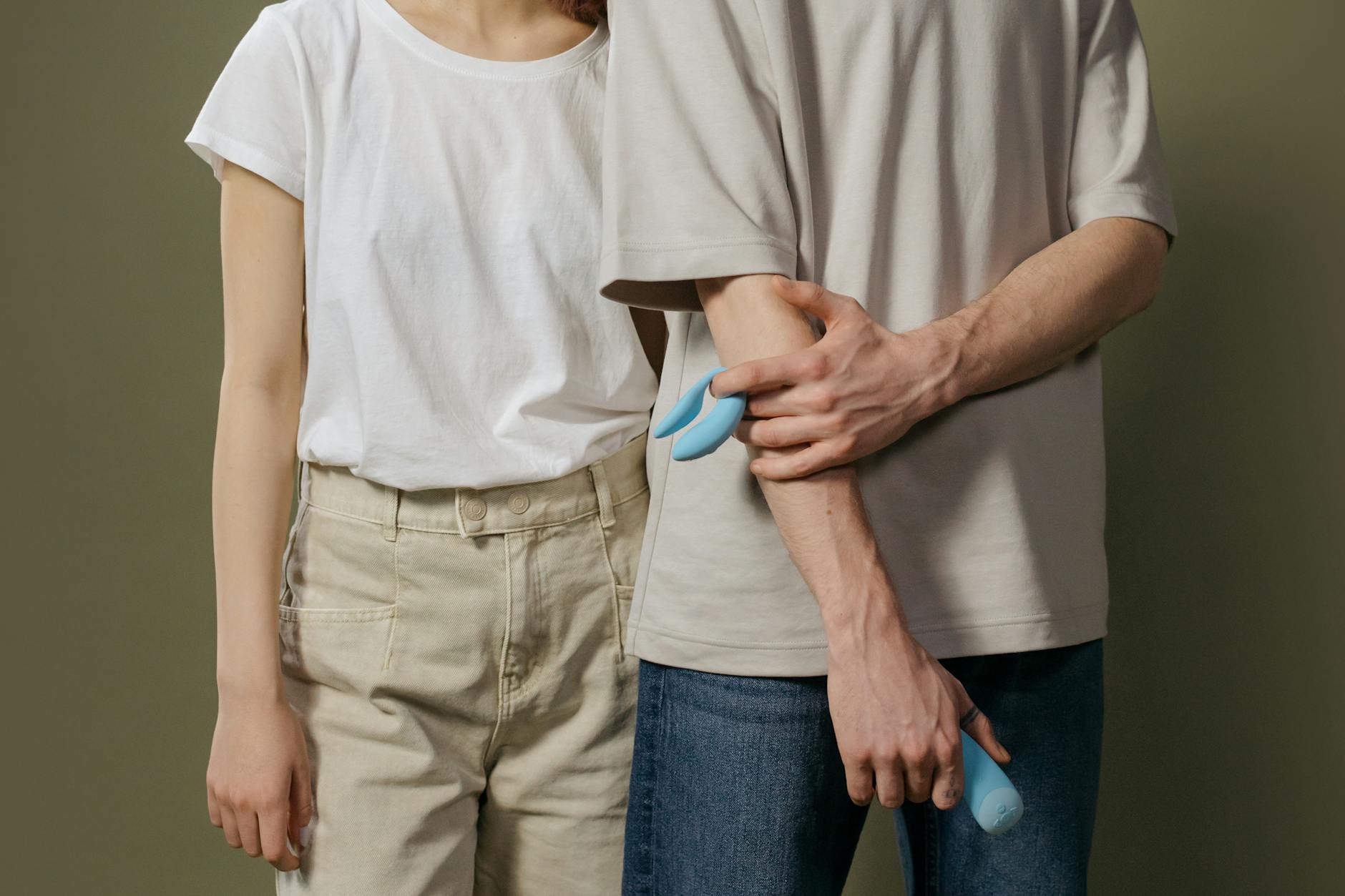
Let's name the actual thing you're feeling
You're not broken. You're not weird. You're not the only person who feels a flutter of anxiety when considering a lemon vibrator for the first time. That nervous feeling has nothing to do with whether toys are "right" or "wrong." It has everything to do with what vibrators represent in your internal world.
I've worked with hundreds of couples navigating this exact threshold. The anxiety shows up differently depending on who you are. Sometimes it's pure performance pressure. Sometimes it's residual shame from how you were raised. Sometimes it's the vulnerability of admitting you want something that might feel selfish. And sometimes it's genuinely practical: you don't know what to expect, and uncertainty always triggers a small alarm bell in the nervous system.
Here's what I've learned: the anxiety itself isn't the problem to solve. The problem to solve is understanding where it comes from so you can move forward with actual information instead of assumptions.
The most common source: you're confusing a toy with a commentary
This one lands hardest on people who grew up hearing (directly or indirectly) that "real" intimacy doesn't need tools. That reaching for a lemon vibrator means your body is failing, your partner isn't enough, or you're admitting to wanting something shameful.
All of that is historical baggage, not truth.
Here's the reframe: a clitoral vibrator like the Lem isn't a replacement for anything. It's not saying "my partner isn't good enough." It's saying "my body responds to this specific kind of stimulation, and I deserve to feel good." Those are completely different statements. A lemon sucker isn't an indictment of your relationship. It's data about your physiology.
One way to test whether this is your source: imagine your partner used a toy during solo pleasure, then came back to you. Would you feel insulted? Or would you feel curious about what works for their body? Most people feel curious. That same curiosity should extend to yourself.
The second most common: you're protecting against rejection
Vulnerability is the precondition for true intimacy. It's also terrifying.
When you say to a partner "I want to try a lemon vibrator," you're not just asking for logistical permission. You're making a declaration that this matters to you. You're saying out loud something you want. And if they respond with dismissal, judgment, or even just "I'm not sure," it lands different than if you'd kept it private.
The anxiety here is actually protective. It's your nervous system saying "this exposure carries risk." That's accurate. Vulnerability does carry social risk. The question is whether the potential intimacy payoff is worth it.
For most couples, it is. Because when both people move through that initial discomfort together, something shifts. You're not just trying a toy. You're practicing the skill of asking for what you want and having it received with care.
The third: you genuinely don't know what to expect
Uncertainty creates anxiety. That's not emotional, that's neurobiology.
You might be worried about noise levels, or whether it will feel overwhelming, or whether you'll climax too fast or not at all, or whether you'll "need" it going forward, or a hundred other unknowns. The specifics don't matter. What matters is that you're about to cross into unmapped territory with your body, and your brain is doing its job by flagging that.
The antidote here is information and permission to experiment.
Know the basics: lemon vibrators are quieter than you expect. The sensations are specific but not mandatory. First use doesn't define future use. Your body's response is the right response, whatever it is. You don't need to achieve anything. You're just gathering data.
That's enough to move from "I'm nervous" to "I'm curious and slightly nervous, which is actually fine."
How to move through it with a partner
If you're navigating this as a couple, the conversation is everything.
Start before you buy anything. Not "Should we get a toy?" but "I've been thinking about trying a lemon vibrator. I feel nervous about it, and I want to talk through why." That sentence does three things at once: it signals something is important to you, it invites them into the vulnerability, and it frames the toy as secondary to the conversation.
Listen to what they say without defending. If they feel hesitant, ask what's underneath it. Is it their own discomfort? Worry they're not enough? Practical concerns about privacy? Those are all valid and all worth naming.
Then decide together. "This matters to me, and your comfort matters too. How do we move forward in a way that feels good to both of us?"
Sometimes that looks like solo exploration first. Sometimes it looks like them being present but not directly involved. Sometimes you move straight to partnered use. The structure matters less than the agreement.
The practical reset that helps anxiety most
Once you've had the conversation, separate the anticipation from the execution.
Don't build it into a big sexual event. The first time you use a lemon clitoral vibrator doesn't need to be a production. Try it solo first if you're alone. Try it as part of a longer intimate session if you're with a partner, but don't make it the main event.
Give yourself permission for it to be weird or awkward or not what you expected. Your nervous system needs to see that you survive the experience. Then the next time, the anxiety will be smaller because your body has evidence that nothing catastrophic happened.
Also: manage external stressors. Don't try this for the first time when you're exhausted, stressed about work, or distracted. Your nervous system is already firing on cylinders. You want to approach something slightly outside your comfort zone when you have reserves to draw on.
What happens on the other side
The couples I've worked with who push through the initial anxiety almost always report the same thing: doing it together shifted something in how they related to each other's pleasure.
It wasn't about the lemon vibrator itself. It was about saying "your pleasure matters to me, and my pleasure matters to me, and we can hold both of those things at the same time." That's a different relationship dynamic than the one most people are taught.
The anxiety wasn't the problem. It was the doorway.
People also ask
Is it normal to feel nervous about using a lemon vibrator for the first time?
Completely normal. You're about to introduce something new into an intimate context, which activates both vulnerability and uncertainty. Both of those trigger the nervous system. What matters is that the nervousness is about the newness, not a sign that you shouldn't do it.
Will my partner feel threatened if I bring up wanting to try a lemon sucker?
Not necessarily, but it depends on how you frame it. The difference between "I want to try a vibrator because you're not enough" and "I want to explore my own body and I'd like you to be part of that" is everything. One invites defensiveness. The other invites participation. The toy is the same in both scenarios. The conversation changes everything.
How do I know if the anxiety I'm feeling is reasonable or a sign I shouldn't do this?
Reasonable anxiety feels like "I'm nervous about something new." Red-flag anxiety feels like "I'm being pressured into this against my values" or "I feel shame about wanting this." The first kind is normal and workable. The second kind is worth examining more deeply, ideally with a therapist who specializes in sexuality or relationships.
What if I try it and hate it?
Then you've learned something about your body. People's preferences for lemon vibrators, intensity levels, and stimulation types vary wildly. Not loving a particular toy doesn't mean toys aren't for you. It means that specific tool wasn't the fit. The information is valuable even when the outcome is "not for me."
Should my partner be in the room the first time I use a lemon clitoral vibrator?
Thatally depends on your comfort and theirs. Some people feel more relaxed exploring solo first. Others feel more secure knowing their partner is present and supportive. There's no universal right answer. Go with what allows both of you to feel safe and respected.
How do I talk to my partner about lemon vibrators without it becoming awkward?
Same way you'd talk about anything that matters: directly, without apology, and with genuine curiosity about their perspective. "I've been thinking I want to explore this, and I'm feeling nervous about bringing it up. But it matters to me, so I want to tell you." That honesty dissolves a lot of awkwardness because you're not pretending it's casual when it's not.
The thing underneath
Most of the anxiety around lemon vibrators isn't really about the toy. It's about permission. Permission to want something. Permission to ask for it. Permission to prioritize your own pleasure without guilt or shame.
The vibrator is just the practical expression of something deeper. Which is why working through the anxiety is so often transformative. You're not just learning to use a toy. You're practicing the skill of desiring something and pursuing it anyway, even with nervous hands.
That skill changes everything.
If you're ready to explore more, our guide to getting started with a lemon vibrator walks you through the first-use basics. And if you're navigating this with a partner, we have a whole resource on how to use a lemon vibrator together without the awkward conversation getting in the way.
Your pleasure matters. Your nervousness is normal. Both of those things are true at the same time.